
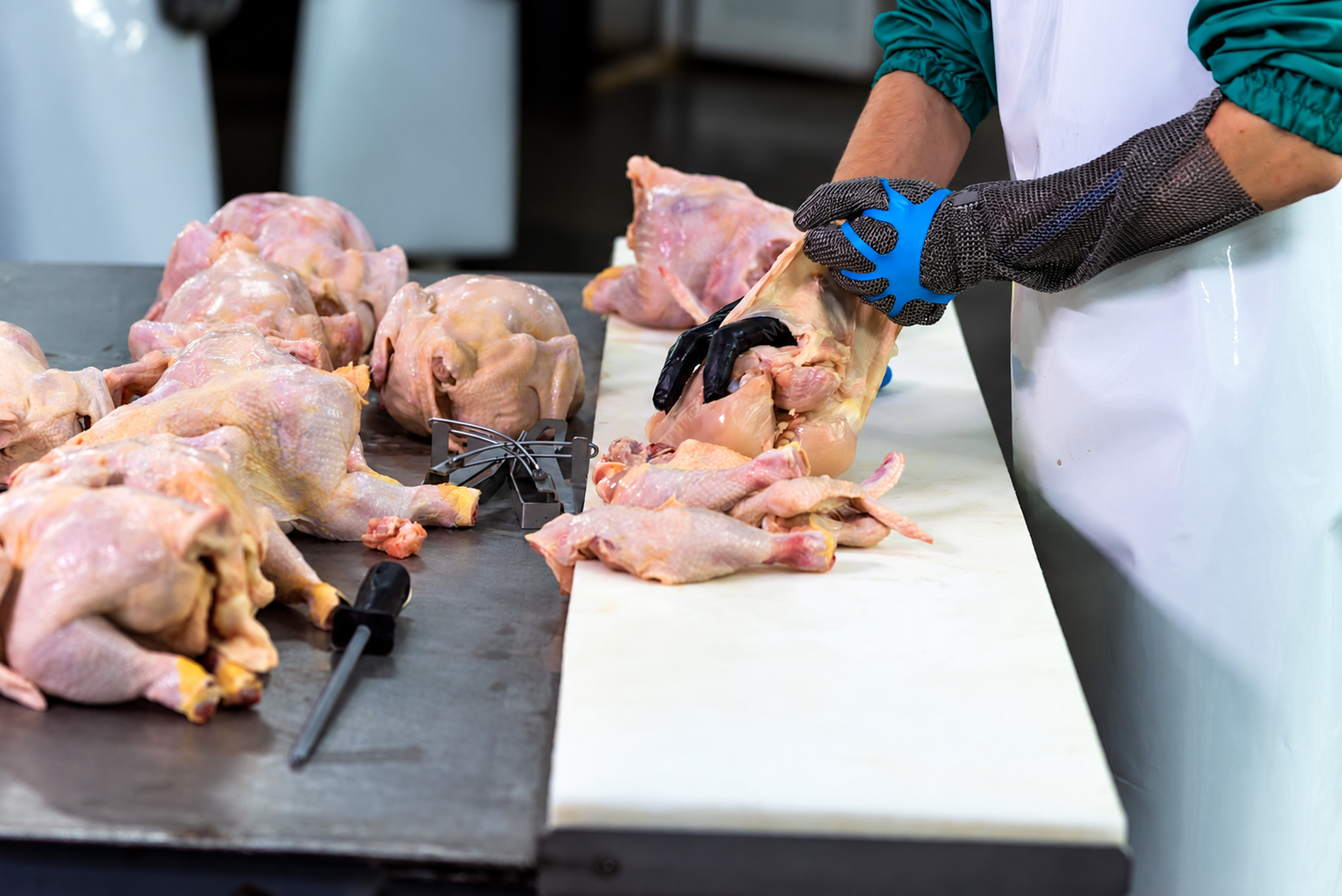
Poultry meat production continues to outpace other meat sources like pork, beef, and sheep. It is expected to exceed 139 million metric tons in 2023, marking an almost 3% increase compared to 2022, primarily driven by increased production in Brazil and the United States1. China exported 628,500 tonnes of poultry meat for a total export value of $2.212 billion from January to December 2022. Approximately 80% of these exports originated from countries including Brazil, the United States, and Russia. The largest share of the exported goods was chicken, accounting for 84.7%, followed by duck and goose meat (12.8% and 2.5%, respectively)2. According to He and Liu, processed products comprised 57.4% of exports, followed by frozen products (28.0%) and chilled products (14.6%)2. The share of poultry meat in total meat production increased from 8.3% in 1985 to 26.57% in 2021, highlighting the rapid development of the poultry industry. However, because of the rapid growth of modern intensively farmed poultry, the complexity of factors affecting the production and processing of poultry meat makes it difficult to ensure the production of high-quality poultry meat for the market2. The influence of economic development and increased consumer health awareness has led to substantial growth in poultry consumption in regions like Asia, particularly in China and India. Similarly, Western countries have a growing preference for organic and antibiotic-free poultry products3. Consequently, research focused on improving poultry meat quality has also increased. This includes efforts to enhance feed efficiency, optimize genetic selection, and improve management practices to ensure better meat quality. Additionally, heightened consumer awareness of food safety, animal welfare, and environmental sustainability is prompting the industry to adopt stricter standards and innovative practices in poultry farming and meat processing2.
This consensus is that the carcass quality influences the price of poultry meat. Poultry meat quality has been widely studied in recent years, and its evaluation has become a growing demand in the international market. As consumers become more discerning, they are not only concerned about sensory and nutritional properties but also the visual appeal of the meat. Modern poultry breeding, which often involves intensive indoor breeding conditions, can lead to skin pigmentation, scratches, and other skin lesions. These problems affect the visual quality of poultry carcasses4. Health performance is a significant concern in the poultry industry. Factors including heat stress and nutritional and metabolic diseases due to improper poultry management can affect the health of the poultry and, consequently, the meat quality5. The feed’s nutritional composition and the feed additives’ composition are also essential in influencing the quality of the meat. Still, it must be mentioned that feed deterioration, such as contamination with mycotoxin, heavy metals, and chemicals, has an even more severe effect on poultry meat quality4.
In recent years, researchers have been investigating effective ways to enhance meat quality in response to risks to poultry meat quality posed by various influencing factors. Probiotics are a group of beneficial microorganisms that help maintain the balance and health of the host’s intestinal microbiota. They can increase poultry’s daily weight gain and feed conversion ratio, thereby improving productivity. Probiotics can also positively affect poultry meat quality through various mechanisms, such as increasing the content of polyunsaturated fatty acids, lowering the content of saturated fatty acids, and minimizing oxidative damage to the meat6. Prebiotics are organic substances that stimulate the growth and activity of beneficial intestinal microbiota. Prebiotics also change the composition of gut microbes and increase the flavor substances in meat. Additionally, prebiotics have improved growth performance, immunological function, and meat quality in poultry7. Plants and plant extracts have attracted attention for their naturalness, non-toxicity, and unique biological activities. These plant extracts have been demonstrated to be beneficial in enhancing poultry meat quality and growth performance, in addition to being a natural substitute for synthetic chemical additives8. This review suggests improvement strategies for poultry meat quality to meet consumer demand for high-quality meat. It underscores the importance of scientific agricultural management and quality feed selection, and it calls for further research to explore the practical application and effectiveness of these strategies for the sustainable development of the poultry industry.
Meat quality evaluation indexes
Meat color
Meat color is one of the commercially important characteristics of meat quality because consumers associate the appearance of meat with the freshness of the product, and meat color substantially influences consumer willingness to purchase. Research shows that consumers usually associate bright cherry-red or pink meat with freshness and quality, while discoloration or browning leads consumers to believe the meat is spoiled and of lower quality9. This perception directly impacts marketability, as meat products that do not meet these color expectations are likely to be rejected by consumers, regardless of their actual quality or safety. Myoglobin, hemoglobin, and cytochrome C are the primary heme pigments present in meat9. The red color and discoloration of myoglobin are determined by the chemical state of myoglobin, which is influenced by some factors, including pre-slaughter factors (genetics, feed, handling, pressure, heat and cold pressures, and gaseous environments), and slaughter, freezing, and processing conditions (nitrates, additives, and pH)10. Temperature and pH after the animal has been killed have an effect on the degree of protein denaturation as well as the physical appearance of the meat. These two parameters affect the reflection of light from the exterior and interior of the meat surface, as the reflection of light is directly proportional to the degree of protein denaturation11. The effect of light reflection on meat color L* is opposite to that caused by hemoglobin concentration and has the least effect on meat color a* and b*4. Protein denaturation in muscle is limited when the pH level is ≥6.0, and the lower the light reflection the greater the transparency of meat appearance. However, muscle suffers from protein denaturation at pH levels below 6.0, which causes an increase in opacity and light reflection4.
Meat tenderness
Tenderness is the most essential quality factor in consumer satisfaction with poultry meat. Tightly bound to muscle proteins, water has a swelling effect on muscle proteins, occupying the space between muscle fibers and giving the meat a firmer structure12. The rate and extent of chemical and physical alterations in the muscle during the poultry slaughter also determine the meat’s tenderness13. When a chicken is slaughtered, blood circulation within the muscle stops, preventing oxygen or nutrients from reaching the muscle; when the muscle is depleted of energy, it contracts and becomes stiff; with time, the meat will soften again, making it tender when cooked13. The main determinants of meat tenderness are the maturity of the connective tissue and the contractile state of the myofibrillar proteins, environmental stresses, the bird’s age, the rigor mortis development rate, and the freezing rate and duration14. Moreover, the contractile state of myofibrillar proteins depends on the rate of development of rigor mortis and the severity of post-slaughter rigor mortis. At the same time, the maturity of connective tissue can increase with age14. According to Bowker et al.15, the tenderness of the breast muscles of older broilers is lower, and there is an interaction between the maturity of connective tissue and the state of collagen in the muscle.
Various methods are used to precisely measure meat tenderness in research settings, often closely related to consumer perceptions. The Warner–Bratzler shear force (WBSF) test is one of the most widely used objective methods for measuring meat tenderness16. This test involves measuring the force required to cut through standardized meat samples, providing a quantitative value of tenderness. Another commonly used method is texture profile analysis (TPA), which primarily simulates the chewing process by subjecting samples to two cycles of compression. The entire testing process is recorded by a computer, with the software outputting a texture profile curve (force-time curve), from which parameters such as peak, time, and area can be calculated to determine the hardness, springiness, cohesiveness, adhesiveness, resilience, and chewiness17. Additionally, sensory evaluation panels, composed of trained panelists or consumers, are used to assess the tenderness of meat samples, providing subjective indicators to complement objective measurements18.
Meat flavor
Flavor is another quality attribute that influences consumer acceptance of chicken breast meat. Although it can be challenging for consumers to distinguish the flavor and odor of different meats when eating them, different flavors occur in chicken breasts during the cooking process due to interactions between sugar and amino acids, lipid and thermal oxidation, and thiamine degradation19. The lipid-derived compounds (e.g., hexenal, heptenal, octenal, nonenal, undecenal, and dodecenal), as well as aldehydes (e.g., octanal, nonanal, decanal, and dodecadienal), have been associated with the distinctive aroma and flavor of chicken meat20. These specific compounds contribute to different sensory experiences for consumer groups. For example, hexenal and nonenal are associated with grassy and citrus flavors, which some consumers find fresh and pleasant21. On the other hand, compounds such as octanal and decanal impart fatty and citrus aromas, providing rich and full-bodied flavors that enhance the overall dining experience22. According to Jayasena et al. 23, cooking also enhances the flavor of chicken by causing a glycosamine reaction (also known as the Millard reaction). During heat treatments that include temperatures over 100°C (e.g., broiling, grilling, deep-frying, and pressure cooking), large quantities of heterocyclic compounds are formed in the aroma of cooked meat. The pH of the meat itself is important in the Millard reaction for the formation of aroma, with pH values between 4.5 and 6.5 favoring the formation of nitrogenous compounds that contribute to the aroma of the food24. The commencement of the post-slaughter rigor mortis reaction results in the formation of several chemical flavor compounds, such as sugars, organic acids, peptides, free amino acids, and adenine nucleotide metabolites, which are also crucial in shaping the final flavor of the meat25. Due to differences in cultural background, dietary habits, and personal taste preferences, different consumer groups have varied preferences for these sensory attributes. Understanding these preferences is crucial for producers to cater to specific markets and improve consumer satisfaction with their products.